- HEAD PROTECTION
- EYE & FACE PROTECTION
- HEARING PROTECTION
- PROTECTIVE CLOTHING
- DISPOSABLE PPE
- ROAD SAFETY GEAR
- HAND PROTECTION
- FALL PROTECTION
- FOOT PROTECTION
- FIRE SAFETY GEAR
- RESPIRATORY PROTECTION
- SCBA
- GAS DETECTORS

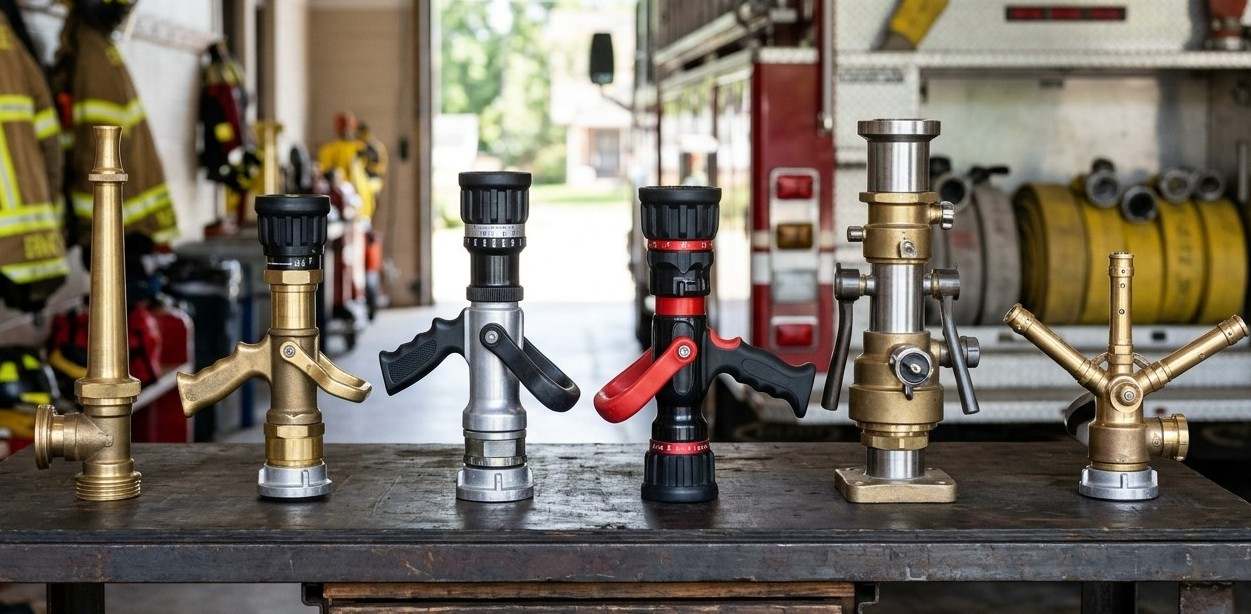
The best fire hose nozzle matches your hose diameter, operating pressure, flow requirement, and hazard. Choose smoothbore for reach, fog or automatic for pattern control, and a 1 inch model for booster lines. Confirm thread compatibility and certification before buying.
A fire hose nozzle controls water pressure, flow rate, and spray patterns during firefighting or industrial use. It decides how far water travels and how safely a crew can work. This guide explains fire hose nozzle types, their uses, and how to select the best fire hose nozzle for your operation.
Table of Contents
A fire hose nozzle is a fitting at the end of a hose that shapes and directs water flow. It converts line pressure into stream velocity, letting operators adjust pattern, flow rate, and shutoff with a bale handle and a rotating pattern ring.
Performance depends on inlet pressure, measured in psi, and flow, measured in gallons per minute (gpm). Standards such as NFPA 1964 define testing requirements for spray nozzles. Always confirm that a nozzle meets the standard your jurisdiction or insurer requires.
The main fire hose nozzle types are smoothbore, fixed-gallonage fog, selectable-gallonage, automatic, and piercing nozzles. Smoothbore units deliver a solid stream with maximum reach, while fog units produce adjustable patterns from straight stream to wide spray. Each type suits different hazards, pressures, and crew skill levels.
Use smoothbore nozzles for high-volume attacks on deep-seated fires, and fog nozzles where pattern control and heat absorption matter. Industrial sites favor adjustable or automatic models, while piercing nozzles serve specialist rescue roles.
A fire hose nozzle 1 inch fits booster lines, hose reels, and forestry hose, delivering low flow for small fires and overhaul. Typical flows run from about 10 to 60 gpm depending on pressure and design, so confirm the rating before use. The light weight lets one operator handle the line alone.
These compact units suit vehicle fires, industrial yards, brush fires, and mop-up work. They are not a substitute for high-flow nozzles on fully developed structure fires.
The best fire hose nozzle matches your hose diameter, water supply, hazard type, and certification requirements. No single model wins in every situation, so define your operating pressure and target flow first.
Use this five-point selection check before purchasing:
You need a fire hose nozzle adapter when your nozzle and hose have different thread types or sizes. Adapters convert connections such as NH to NPSH, or reduce a larger coupling to fit a 1 inch line. They let you reuse existing equipment instead of replacing it.
Every added connection is a potential leak or weak link. Follow these rules:
Maintain a fire hose nozzle by inspecting it after every use, flushing debris, and testing moving parts on a schedule. Clean nozzles keep their rated pattern and flow. Neglected units clog, leak, or stick open.
Follow this routine, which aligns with NFPA 1962 guidance on hose and appliance care:
The right fire hose nozzle balances flow, pressure, durability, and operator control for your specific hazard. Start with the water supply, confirm certifications, and plan for routine maintenance. Match nozzles, adapters, and 1 inch options to your hoses and operating conditions before you buy.
Share your hose diameter, coupling type, operating pressure, and the hazards you need to protect. Jefflax Trading LLC will recommend nozzles and adapters with the right flow, certification, and fit for your operation, and send you a clear quote with no guesswork.
A fixed-gallonage or selectable-gallonage fog nozzle suits beginners. It gives predictable flow and simple pattern control. Automatic models also work well because they adjust to pressure changes without operator input.
A smoothbore nozzle produces a solid stream with greater reach and lower friction loss. A fog nozzle produces an adjustable spray pattern that absorbs more heat and protects the operator. Smoothbore suits deep fires, while fog suits interior attack.
Inspect nozzles after each use and flow test them at least annually. Increase the frequency for heavy use or harsh environments. Replace any unit that leaks, sticks, or fails to meet its rated flow.

March 12, 2025

March 25, 2025

April 2, 2025

April 14, 2025

April 22, 2025


