- HEAD PROTECTION
- EYE & FACE PROTECTION
- HEARING PROTECTION
- PROTECTIVE CLOTHING
- DISPOSABLE PPE
- ROAD SAFETY GEAR
- HAND PROTECTION
- FALL PROTECTION
- FOOT PROTECTION
- FIRE SAFETY GEAR
- RESPIRATORY PROTECTION
- SCBA
- GAS DETECTORS

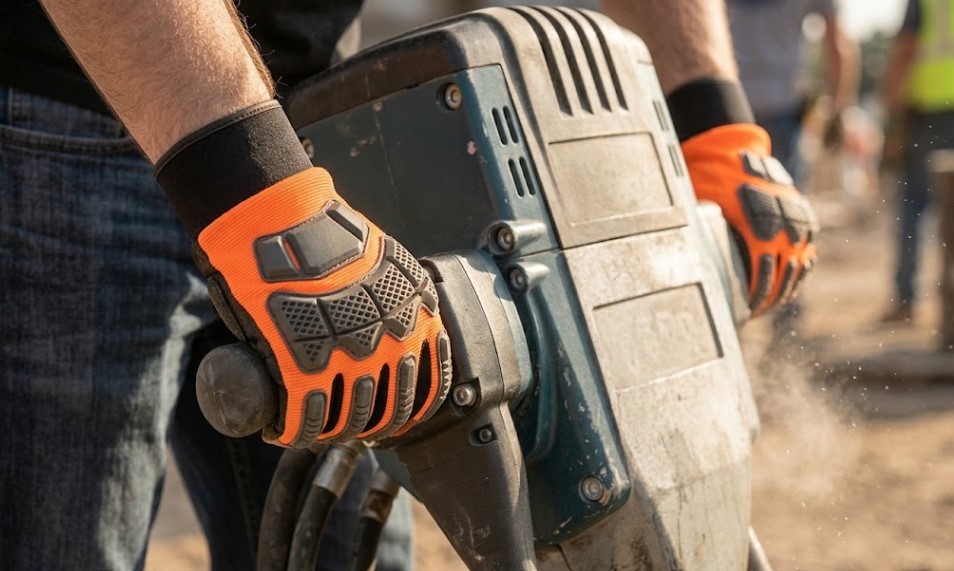
Hand-arm vibration injures operators gradually, and most sites discover the damage only after grip strength and feeling have already declined.
Anti-vibration gloves are one of the first controls managers reach for, yet they are widely misunderstood. This guide explains how anti-vibration gloves work, where they help, and where they fail.
Table of Contents
Anti-vibration gloves work by placing a damping layer of gel, foam, or viscoelastic material between the tool handle and the palm. This layer absorbs part of the vibration energy, mainly at higher frequencies, before it reaches the hand and wrist.
The glove acts as a mechanical filter. The damping layer converts some vibration into heat, so a smaller amplitude reaches finger and palm tissue. Results depend on material thickness, density, and palm coverage.
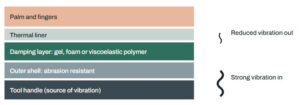
Common constructions include closed-cell foam, gel inserts, air bladders, and viscoelastic polymers. Each balances vibration damping, hand protection, and grip feel differently, so no single design suits every tool.
Anti-vibration gloves reduce high-frequency vibration above roughly 200 Hz well and lower frequencies poorly. ISO 10819 requires a transmissibility below 0.6 in the high-frequency band and below 1.0 in the medium-frequency band, so a glove can pass the test while barely helping against slow, heavy impacts.
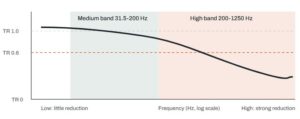
Treat the rating as a laboratory baseline. The standard tests gloves on a defined handle, while your tool, grip force, and posture will differ.
Use anti-vibration gloves when operators run high-frequency percussive or rotary tools, such as grinders, rivet guns, and chipping hammers, and engineering controls have already been applied. They also help when cold conditions threaten blood flow, because the insulating layer keeps hands warm.
Typical use cases include:
Be cautious with low-frequency tools such as rammers and heavy breakers. Bulky padding can also reduce dexterity and add entanglement risk near rotating parts.
Early hand-arm vibration syndrome (HAVS) signs include tingling, numbness, finger blanching, and weaker grip. The HSE guidance on hand-arm vibration explains symptoms and health surveillance duties.
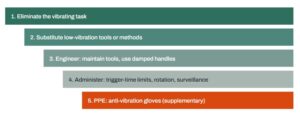
No. Anti-vibration gloves are a last-line control and sit at the bottom of the hierarchy of controls. Eliminating the task, choosing low-vibration tools, maintaining equipment, and limiting trigger time all cut exposure more reliably than PPE, and regulators expect those measures first.
Choose anti-vibration gloves that carry ISO 10819 certification, fit the operator’s hand size, and match the tool’s dominant frequency. Then test grip and dexterity on the actual task, because thick padding that forces a tighter grip can erase the vibration benefit.
Use this selection checklist:
Edge cases matter. Oil, heat, and repeated compression degrade damping long before outer fabric shows wear.
Anti-vibration gloves can help reduce vibration exposure, keep hands warm, and provide added hand protection when working with suitable tools and equipment. As part of its hand protection range, Jefflax Trading LLC supplies PPE solutions for different workplace hazards in Dubai, UAE.
However, anti-vibration gloves should not be considered a standalone solution for high-vibration tasks. Select certified gloves, assess their effectiveness during actual use, and combine them with controls that prioritize eliminating, substituting, or reducing vibration at its source.
Get exposure data you can defend in an audit
Need reliable exposure data for safety compliance? Our engineering team can help you explore custom enterprise automation solutions designed to support accurate monitoring, reporting and audit requirements.
No. Anti-vibration gloves reduce exposure to some frequencies but do not prevent hand-arm vibration syndrome on their own. Prevention requires lower-vibration tools, maintained equipment, limited trigger time, lower grip force, health surveillance, and gloves used only as a supplementary control.
No. Thicker padding can reduce dexterity and push operators to grip the tool harder, which increases vibration transfer into the hand. Choose the thinnest certified glove that meets the transmissibility requirement, then verify comfort and control on the intended tool.
Replace anti-vibration gloves when padding compresses, tears, or hardens, or when the glove no longer fits securely. Inspect them before each shift, and record issue dates, because damping materials degrade with heat, moisture, oils, and repeated compression, often long before the outer fabric looks worn.

March 12, 2025

March 25, 2025

April 2, 2025

April 14, 2025

April 22, 2025


